Home Assistant 2026.11 is out: a built-in Marketplace, Matter cameras and a naming change to prepare for
The final release replaces HACS with a Marketplace inside Home Assistant, adds Matter 1.5 cameras and changes how entities are named. Here is what the official notes say, and what to check before you press Update.
By Andrew Ingleton · Published · updated 5 November 2026
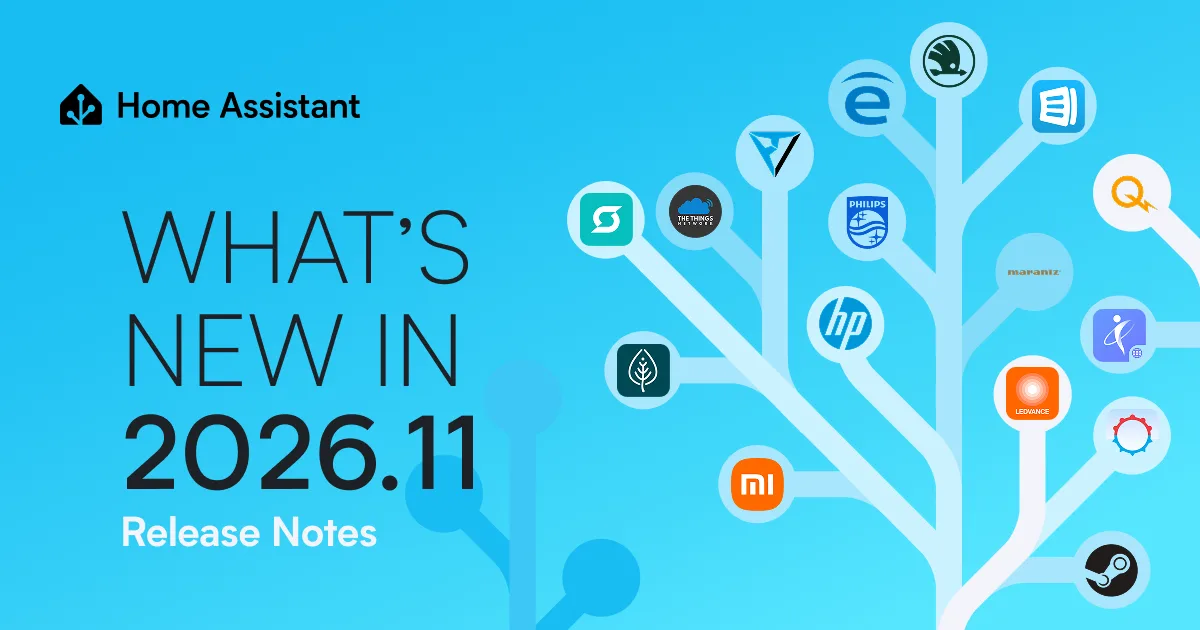
Home Assistant 2026.11, titled "A lot in store!", was released on 4 November 2026. It is the release that turns the community store into part of the product, adds Matter camera support and changes how entities are named on your dashboards. This article replaces our beta preview and is based on the official release notes. We have not installed it ourselves, and the notes are long: check the full "Backward-incompatible changes" list before updating a house that depends on it.
A built-in Marketplace replaces HACS
The headline change is Settings, Marketplace, available on every installation type without separate setup. It installs integrations, dashboard cards, themes and templates; new integrations do not need a restart, though updates still do. Project pages show download counts, GitHub stars and the Home Assistant version a project needs, and installed projects get update entities like any other device.
- Browsing needs no acknowledgement, but installing or updating requires you to accept a notice that community projects are not reviewed by Home Assistant.
- Custom repositories are added by URL and use GitHub device sign-in, with read-only access to public data.
- Existing HACS users are migrated automatically, and the separate HACS installer stops working at this version.
During the beta, community write-ups (notably simon42) flagged some edge cases: AppDaemon apps and Python scripts that HACS used to manage, dashboard resources that move to a new folder, and templates that call integration_entities('hacs'). We could not confirm these in the final notes, so search your own setup for them before you update.
Entity naming: the change to prepare for
Entities are now named from the device name plus the entity name, with area context added where it helps. Entity IDs do not change, so automations keep working, but cards and badges without a custom name may show longer labels. The release adds a "main entity of the device" option, child devices for multi-part devices (Tuya multi-channel switches first), and keeps old names as voice aliases. The notes say the friendly_name attribute is planned for deprecation in favour of new template functions, so it is worth starting to move templates over.
Matter cameras and two-way audio
Matter 1.5 cameras now appear as camera entities with WebRTC live video, snapshots and the privacy-mode state. You need a recent Matter server. A Labs preview adds a talk button for Matter cameras and Reolink cameras (Reolink needs RTSP); because browsers only allow microphone access over a secure connection, it currently requires HTTPS.
Automations and dashboards
- Target exclusions: exclude entities, devices, areas, floors or labels from a target in triggers, conditions and actions. Exclusions are re-evaluated at run time, so "all lights except the kitchen" also skips a kitchen lamp you add later.
- Dashboards: copy, cut and paste sections between views and dashboards; new automatic sections (Common controls, Device, Entities) that update themselves and can be converted to manual; a Date card, an Alert badge and a visual editor for the Alert card.
- Forms and blueprints: conditional form fields, and blueprint inputs that depend on earlier answers.
- Energy: energy can be derived from a power sensor, and gas or water totals from flow-rate sensors.
Easier troubleshooting
A "Why did that happen?" theme runs through the release: a "Triggered by" filter in Activity, traces that link to sub-script and sub-automation runs, per-integration live logs, deletion of statistics by time range with a preview, drag-to-zoom charts, and a new Action history tab in Settings, Tools with a re-run option.
Storage, radios and integrations
- Backups and media can go to internal or USB disks. Restores no longer make a temporary full copy, and there is a new sensor for the size of the last automatic backup.
- LoRaWAN gets its own page under Settings, Connectivity (ChirpStack, The Things Network, SenseCAP devices), and ZHA supports Zigbee Green Power batteryless devices.
- ESPHome can share a serial port over the network; UniFi Protect gains Alarm Hub support; Shelly, Tuya, Bosch SHC and ZHA groups all improve.
- The release lists 38 new integrations, including Seafile, HP Printer, Flic, Skoda, AnyList and several infrared device types. Flipr is removed because the company behind it was liquidated.
Should you update on day one?
Take a full backup and copy it off the machine first, then check your templates for hacs and friendly_name and update custom cards before the core. As with any x.0 release, if the house depends on it, give it a few days for the first patch. Our review of the previous release is in Home Assistant 2026.10.