A 25 TOPS AI board for the Raspberry Pi 5: what the Sixfab AI HAT+ can and cannot do
Sixfab's new add-on pairs a Pi 5 with a DEEPX neural processor for cameras and small language models. Raspberry Pi's own news post gives benchmark figures, and some honest limits.
By Andrew Ingleton · Published
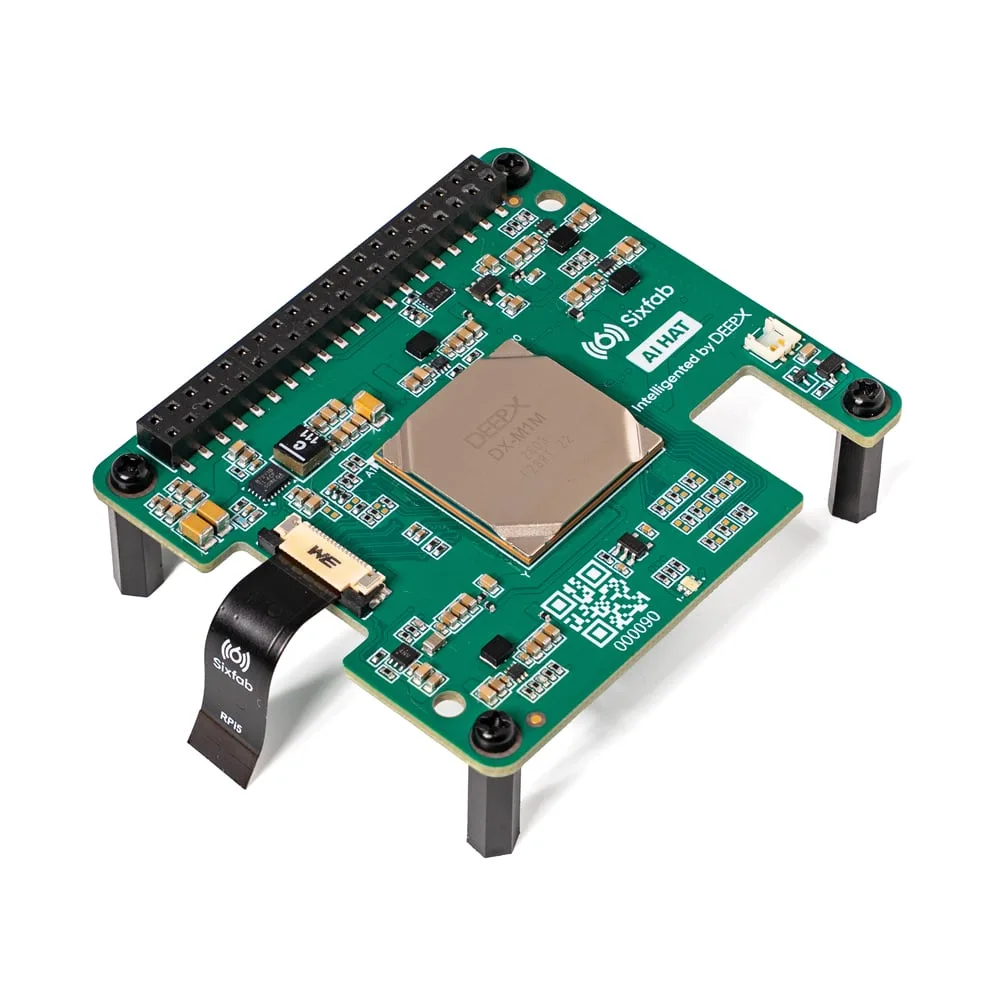
Raspberry Pi's news site has featured a third-party accelerator for the Raspberry Pi 5: the Sixfab AI HAT+, built around the DEEPX DX-M1M neural processing unit (NPU). It is separate from Raspberry Pi's own AI HAT+ range, and it is aimed at always-on vision and small local AI models. If you have been wondering whether a Pi can do useful AI work without a cloud service, this is worth understanding.
The hardware
- Accelerator: DEEPX DX-M1M NPU, rated at 25 TOPS.
- Power: about 3 W typical sustained NPU power. This is the NPU only, not the whole system, so measure your own set-up.
- Memory: 2 GB of on-module LPDDR4x.
- Variants: the 25 TOPS board is available now; a 13 TOPS version is expected towards the end of 2026. No price is given in the post.
The Pi's own CPU stays free for the camera, the application logic, networking and device control.
What it runs
The post covers three kinds of workload: classic vision models (object detection, classification, segmentation, pose estimation, depth), compact vision-language models that can describe a scene or answer questions about an image, and small language models for interpreting commands or summarising events. Models must be in ONNX format and compiled with DEEPX's tools, or taken from its ready-made model zoo. That toolchain is not a one-click install, so expect some tinkering.
Benchmark figures
Tested on a Raspberry Pi 5 with 8 GB of memory, using Sixfab's software release:
| Workload | DX-M1M (this board) | DX-M1 (faster sibling) |
|---|---|---|
| MobileNet v2, 240×240 | 2,361 frames per second | 3,223 frames per second |
| DeepLabV3+, 512×512 | 155 frames per second | 231 frames per second |
| Qwen3-1.7B, 96-token prompt | 0.6 s to first token, 4.64 tokens per second | 0.54 s, 11.6 tokens per second |
The post puts the gap down to memory: the DX-M1 uses faster LPDDR5, the DX-M1M uses LPDDR4x. At under five tokens per second, a small language model is usable for short answers, not for long conversation.
Is it for you?
The post itself is candid: the board is not a replacement for cloud AI, and is unsuited to tasks needing broad world knowledge, very long context or continuous learning. It is best for narrow jobs next to a camera or sensor, such as spotting people or parcels, counting, or classifying events. That fits well with a local-first smart home, for instance feeding detections into Home Assistant (see Home Assistant 2026.10).
Before buying, remember what a Pi 5 costs now (what a Raspberry Pi costs in late 2026), and note that this is a niche add-on from a third party, so check software support and warranty with Sixfab. If you simply want a spare PC to run services, the Raspberry Pi Desktop for PC and Mac story may be more relevant.
Source: Raspberry Pi news, "Seeing, understanding, and responding: low-power CNN, VLM and SLM workloads on Raspberry Pi 5" (5 October 2026). Performance figures are those reported in the post.