Pi-hole or AdGuard Home in 2026: which network-wide ad blocker should you run?
Both block adverts and trackers for every device in the house. Here is how they differ now that Pi-hole has dropped cloudflared and AdGuard Home handles encrypted DNS natively.
By OwnYourStack Admin · Published
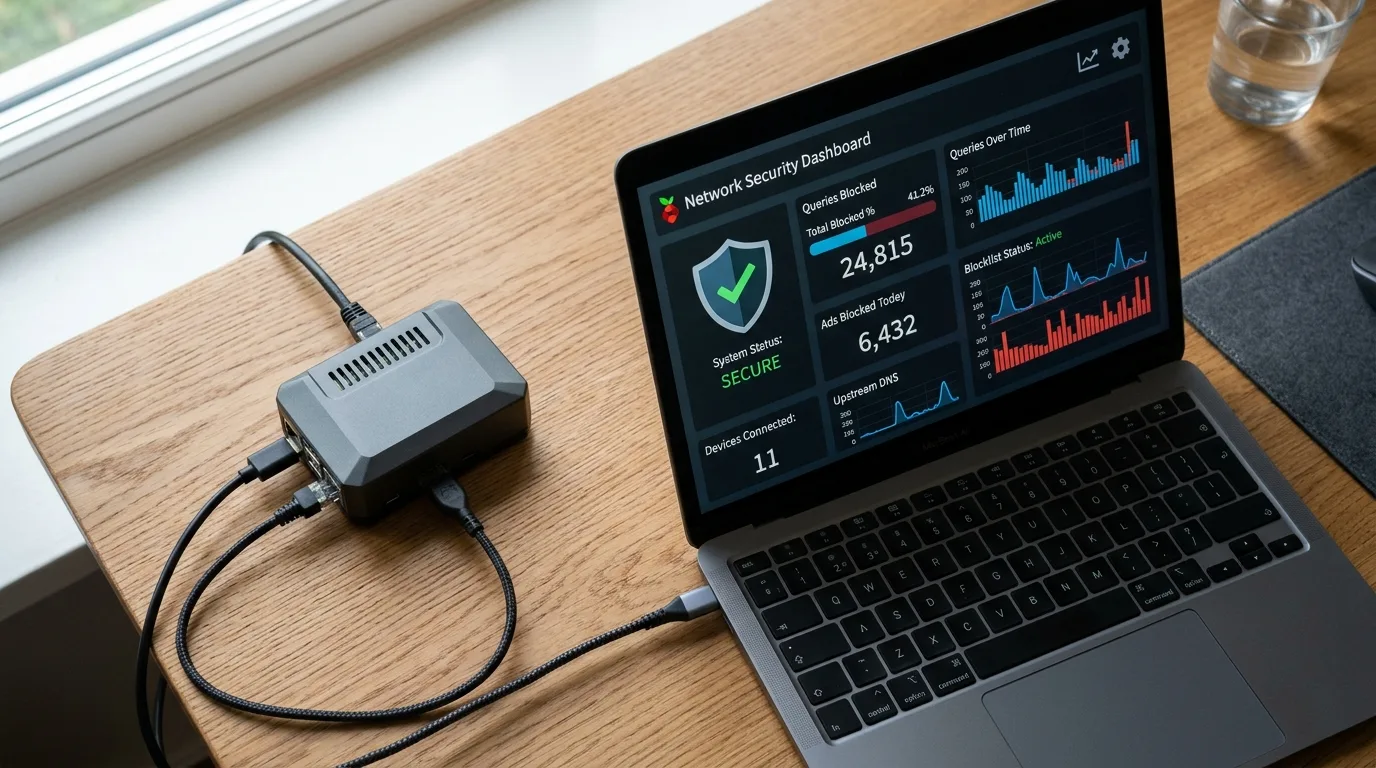
A network-wide DNS filter is one of the most rewarding weekend projects for a home lab: install it once on a spare Raspberry Pi, mini PC or Proxmox container, point your router at it, and every phone, TV and laptop in the house stops loading a large share of adverts and trackers. Two projects dominate: Pi-hole and AdGuard Home. Both are free and open source, and in 2026 the choice comes down to a handful of differences.
How they work
Both act as your household’s DNS server. When a device asks for the address of a known advertising or tracking domain, the filter answers with nothing, so the request never leaves your network. No browser extension is needed, which is why it also covers smart TVs and games consoles. The honest caveat: DNS filtering cannot remove adverts served from the same domain as the content (YouTube is the usual example), and out of the box both tools block less than people expect until you add extra blocklists.
Side by side
| Pi-hole | AdGuard Home | |
|---|---|---|
| Runs on | Linux, Raspberry Pi, Docker | Windows, macOS, Linux, Raspberry Pi, Docker |
| Encrypted DNS (DoH, DoT, DoQ) | Not built in: needs Unbound or dnscrypt-proxy as an extra service | Built in, all three protocols |
| Per-device rules | Groups: powerful but more manual | Per-client rules, service blocking and parental controls built in |
| Local DNS records | Dedicated Local DNS section | Through custom filtering rules |
| Interface | Left-hand menu, Basic and Expert modes, native HTTPS | Top menu (some find it harder to navigate) |
| Blocking quality | Practically identical with the same blocklists | Practically identical with the same blocklists |
| Resources | Light: about 30 MB more memory than AdGuard Home in one test | Light |
| Community | Larger and long established | Smaller, growing |
What changed recently
Pi-hole v6, released in February 2025, was the project’s biggest overhaul: the old lighttpd and PHP stack was replaced by a built-in web server and REST API, configuration moved to a single file, and subscribed allowlists arrived. Development is still active, with releases through the summer of 2026. One change matters for privacy-minded users: cloudflared, long the standard way to add DNS-over-HTTPS to Pi-hole, was deprecated in late 2025 and removed from new releases in February 2026, so encrypted upstream DNS now means running Unbound or dnscrypt-proxy alongside it.
Which should you choose?
- Choose Pi-hole if you want the biggest community, plenty of tutorials and a tidy local DNS section. Reviewers still call it the better choice for most people.
- Choose AdGuard Home if you want encrypted DNS without extra moving parts, or if per-child filtering and parental controls matter. It also runs happily on a Windows or Mac machine if you do not own a Pi.
- Either way, performance is not the deciding factor. Server load and resolution speed are practically the same, and your upstream resolver and location matter far more.
Setting it up well
- Run it on an always-on device. A Raspberry Pi works, as does a small mini PC: one popular model was measured at around 10 W while running three virtual machines.
- Give the device a fixed IP address, then set it as the DNS server in your router’s DHCP settings so every device uses it automatically.
- Add a second instance on another device, or keep a fallback resolver, so the household is not offline when you reboot the first one.
- Add one or two well-maintained blocklists, then watch the query log for a few days before adding more. Aggressive lists break apps and websites.
- Remember that browsers and some apps use their own encrypted DNS. If a device appears to ignore your filter, check its secure DNS setting.
If you are building a home lab from scratch, our guides to Proxmox VE and Raspberry Pi pricing are a good place to continue.
Comparison data from WunderTech (updated August 2026).